Insurance Doesn't Need Your Coworkers Anymore
Lemonade used AI to multiply revenue and margins while shrinking headcount. Over 90% of claims are automated and the marginal cost of a new customer is approaching zero. If your job runs on structured information processing, your industry is probably next.

More growth, fewer people. Lemonade just showed what happens when AI moves from keynote slide to payroll line. In five years, the AI-first insurer multiplied its gross profit by a vertiginous 27x, tripled its customers... and cut headcount.
None of this comes from a McKinsey deck. These are quarterly earnings, published openly. Anyone can read them. And if you work at a desk for a living, you should – because your industry could be next.
The Receipts: Lemonade, Proof by the Numbers
For over a century, insurance ran on a simple rule: more customers meant more employees. More policies to underwrite, more claims to process, more calls to answer.
Lemonade broke that.
Here are the numbers, pulled straight from their Shareholder Letters, 2020 through 2025:
- Revenue: $128M (2021) → $714M (2025). A 5.6x increase.
- Gross profit: Under $10M → $273M. A 27x increase.
- Customers: 1.1 million → 3.2 million.
- In force premium (the total annual value of all active policies): $252M → $1.27 billion.
- Headcount: Peaked at roughly 1,500 in 2022 after the Metromile acquisition. Cut by 20% in 2023. Today: around 1,100 to 1,200 people.
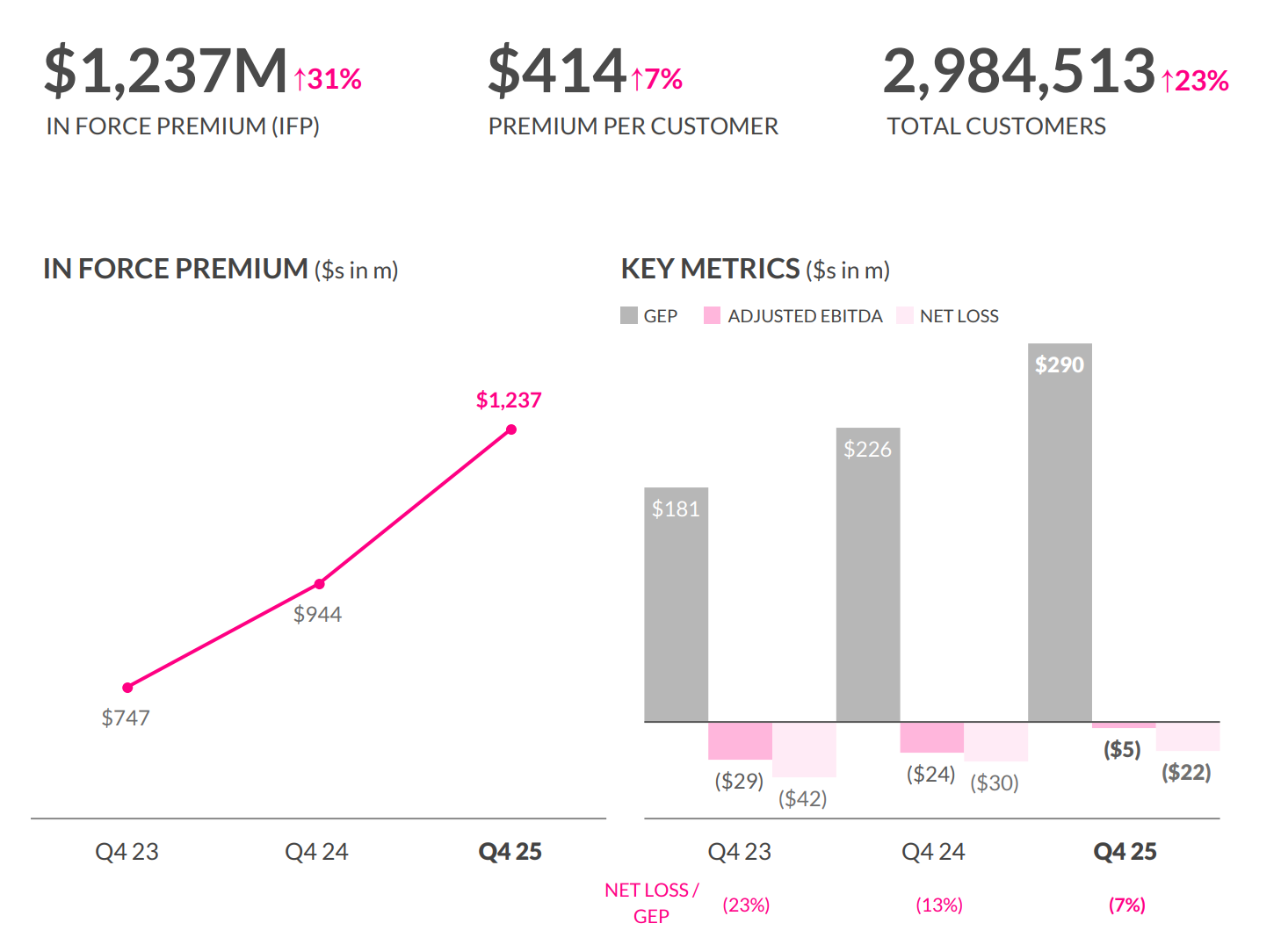
Nearly three times the revenue. Fewer people.
One ratio puts that in perspective. Progressive, the industry giant, generates about $1.2 million in revenue per employee. That's an excellent number for insurance.
Lemonade sits around $600,000. Lower, sure. But the trajectory tells a different story: that ratio has been roughly doubling every year at Lemonade since 2022. At Progressive, it inches up a few points.
The inflection point came in Q2 2025, when Lemonade posted positive free cash flow of $25 million. First time ever. A year earlier, they were still burning cash. Between Q1 and Q3 of 2025, they added 325,000 customers while improving margins. No new hires.
The marginal cost of a new customer is approaching zero. Insurance sells a probability calculation, nothing physical. And calculations are exactly what AI does better, faster, and without a lunch break.
Over 90% of Lemonade's claims reportedly get processed with no human involvement. Fifty AI models run on every single policy application.
Their loss ratio (the key metric that shows whether pricing actually works) dropped from 121% in early 2021 to 56% by the end of 2025. Every point down means the algorithm is getting better at telling a good risk from a bad one.
"Individualized pricing" stopped being a pitch deck a while ago. It's a P&L now.
In a recent interview with Farzad, CEO Daniel Schreiber takes it even further: he says most customer complaints come from human interactions, not from the automated systems. In this model, humans have gone from cost center to friction point.
So Why Aren't the Big Guys Doing the Same Thing?
They have the money. What they don't have is the architecture.
Their systems were built in layers over decades: homegrown software, siloed databases for underwriting, claims, and customer service. Distribution runs through independent agents and brokers who take 10 to 15% of every premium dollar.
Rewiring all of that means rebuilding the company's nervous system while it's still running. And automating the pipeline means cutting the branch that thousands of independent agents are sitting on.
That's the innovator's dilemma playing out in real time. Move too fast and you cannibalize your own business model.
Progressive and GEICO have decades of data and massive customer bases. If they figure out how to bolt AI onto that foundation, the leverage would be enormous. But will they actually do it before they're forced to?
Tech history generally answers that one: no.
The Pattern: Three Signals, One Verdict
Insurance employs 2.9 million people in the United States. Underwriters, claims adjusters, actuaries, agents, call center workers. Jobs that boil down to: read a file, assess a risk, apply a framework, make a decision. Predictive models and LLMs now do all of this at scale.
An auto claims adjuster looks at photos after an accident. Computer vision does the same thing in seconds, cross-referencing thousands of similar cases. The human becomes a reviewer. No longer the one doing the work.
Behind that word, "reviewer," there's a 50-year-old claims specialist with 25 years on the job. Someone who built their entire career on reading files carefully and negotiating with body shops.
What they're being asked to do now is sign off on an algorithm's decisions. That's a different job. And nobody really walked them through the change.
Insurance just happens to be first. Every industry that runs on structured information processing is on the same track.
The pattern you should be watching for is simple. Three signals:
- Strong revenue growth
- Rising profit margins
- Flat or declining headcount
When all three show up in a sector at the same time, that's a structural shift, not a blip.
And that pattern is already showing up elsewhere.
Banking. Approving a loan means estimating default probability. Catching fraud means spotting anomalous patterns. JPMorgan already uses advanced language models like DocLLM to analyze complex contracts and financial documents and automate parts of their reporting workflows. The volume‑to‑headcount gap is widening.
Healthcare. Looks resistant at first glance. Human contact, clinical judgment, high stakes. But a huge chunk of the value chain still runs on probabilistic diagnosis. In radiology, dermatology, and oncology, specialist AI systems already read images at accuracy levels comparable to human practitioners in controlled studies. Even if consumer-facing apps are still a long way off the mark. The “human as supervisor” model is creeping in here too.
Legal. Precedent analysis, document production. Tools like Harvey are already automating large parts of case law research and multi‑source legal analysis. What used to take a junior associate hours now gets generated in minutes and reviewed instead of written from scratch.

Now What: How to Tell if You're Next
Interesting stuff to read about. But you're probably not here for the intellectual exercise. You want to know what this means for you.
Three questions worth asking yourself.
Now, not in five years.
1. Does your job run on structured information processing?
You read files. You apply rules. You compare cases. You produce standardized documents. You assess risks or probabilities.
If that sounds like your day, you're in the impact zone. That type of work is exactly what AI automates fastest.
2. Can your company grow without hiring more of you?
Look at your employer's numbers. If revenue is climbing and hiring is flat or slowing for your function, the signal is already there. This isn't some secret restructuring plan. It's visible in annual reports, in job postings, in the size of your team compared to three years ago.
3. Are you an operator or an architect?
The operator runs a process. The architect designs the system, configures it, monitors it, improves it. Lemonade didn't get rid of humans (yet). They got rid of operators and kept architects.
So instead of asking whether AI will replace you, it may be more honest to notice how the work around you is quietly shifting and to decide what that shift means for you.
POST-WORK tracks the end of an equation: the one that made economic growth the natural engine of employment.
Lemonade's numbers are audited financials, not forecasts. And they're telling a story that a lot of industries are about to live through.
Next time, we look at Tesla. Not the car company. The data moat.
- Want clear models to understand how AI is really changing work?
- Concrete breakdowns of what’s happening across industries - and what it means for your job?
- Ideas you can actually use to create more value with less effort?
No hype. 100% signal.