The AI Race is Already Over. Tesla Won It.
Tesla built a living loop: 9 million vehicles that feed one brain, learning from every mistake until the system improves faster than any rival can catch up.

Most companies treat AI like a tool. A feature you bolt onto a product, optimize in a lab, ship to production, then patch when it breaks.
Tesla did something else entirely. They treated AI like a living organism.
Something that grows, fails, adapts, and gets smarter on its own, in the wild, around the clock. On the road. In the rain. At night. Across millions of vehicles, in every country, in every condition imaginable.
I'm not an engineer and I have no background in autonomous driving. But I've spent enough time reading Tesla's public disclosures, teardown analyses, and a remarkably thorough two-part breakdown by nymbusjp on X that it left me with one question:
At what point does software that perceives, learns, adapts, and acts in the physical world start to deserve a different name?
The implications reach far beyond cars.
Fourteen Layers Deep
nymbusjp's breakdown identifies 14 non-negotiable ingredients for unsupervised driving:
The list runs from fleet-wide data collection and smart upload triggers to neural video compression, hardware-in-the-loop training, and a fleet-scale feedback loop that never stops *. I'll focus on the ones that matter most for what follows.
Tesla reportedly has all 14. Legacy automakers, according to the analysis, have zero at the required scale.
Some chinese EV-native players are closer, however.
XPeng, particularly, has its own chip (Turing), its own VLA architecture, an L3 license, and robotaxi plans for 2026. Their CEO actually tested FSD v14.2 last December and publicly set August 2026 as the target to match it.
On Chinese social media platform Weibo yesterday, Xpeng CEO He Xiaopeng shared his experience of testing FSD 14.2 and riding Tesla Robotaxi in Silicon Valley area and speaks highly of its performance. Here is the translation:
— Ray (@ray4tesla) December 13, 2025
Our VLA 2.0 will be released next quarter. Since it’s… pic.twitter.com/TUKJtKpaY1
So yes, the gap is real. It seems to be narrowing in China, but for the legacy auto industry it still looks less like a delay and more like a chasm.
Anyway, those are the ingredients. What's harder to convey on a list is how they lock into each other once the system is running.
How 9 Million Cars Feed One Brain
To understand why Tesla's advantage compounds, you have to see the 4 mechanisms that make it self-reinforcing.
1) The organism feeds itself.
- Around 9 million cars on the road.
- 8 to 11 cameras each, recording 100% of the time.
- A neural codec that compresses raw sensor data while preserving everything the perception network needs (think of it as an AI that decides which pixels matter for driving and throws away the rest).
- Smart triggers on the FSD chip decide in real time which moments matter: A human takeover, a shadow-mode disagreement, a near-miss, fog over a construction zone. Only those moments get uploaded.
The upshot? Petabytes of the most relevant driving data on Earth, harvested automatically, at near-zero marginal cost.
For comparison, BMW's "Data for AI" and Mercedes' "Sensor Data Hub" are opt-in, bandwidth-capped, and legally restricted across Europe. Their real harvest: a few terabytes per month.
2) The organism learns from us.
Every Tesla permanently runs two versions of FSD in parallel.
One drives.
The other watches, predicts, and compares its own decisions to what the human actually does. Every gap becomes a teaching signal. Millions of real human corrections per day, fed back into training without anyone lifting a finger.
9 million unwitting driving instructors, working around the clock.
3) The organism grows on real hardware.
This one is harder to explain, but it might be the most important piece.
Every AI company trains models in high-precision math on powerful GPU clusters, then compresses them to run on cheaper embedded chips.
That compression (quantization) introduces tiny errors that cascade through hundreds of neural network layers. In 99.9% of situations, they're invisible. But in the 0.01% tail, they can be the difference between "empty road" and "child in the path."
The usual workaround? Simulate the compression during training.
The problem? The simulation never perfectly matches the real chip. Different rounding rules, different memory behavior. Close enough for a demo, but not close enough for life or death.
Tesla's move was to remove the simulation from the loop entirely. They built a hybrid supercomputer (Cortex) where the final training phases run on the actual production chips, the same silicon shipping in every car.
The model learns to live with the imperfections of its own body, so to speak. It doesn't discover hardware constraints after deployment. It grows up with them.
4) The organism proves itself.
Every new FSD version ships to a small slice of the fleet first. Real-time monitoring across every metric.
If intervention rates rise, instant rollback. If they drop, gradual expansion.
Tesla can generate billions of validated FSD kilometers in a single quarter. According to nymbusjp's analysis, no other manufacturer comes close to one billion per year.
Safety, in this model, stopped being something you promise to become something you measure.
Now, the honest question.
Could Legacy Automakers Catch Up?
They have budgets, talent, decades of data. GM has Cruise. Volkswagen invested in XPeng's ADAS technology. Hyundai acquired parts of Motional.
But every one of those 14 layers depends on the previous one. No fleet-wide data collection means no shadow mode. No shadow mode means no real-world feedback. No feedback means no statistical proof.
Each missing link breaks the chain. You cannot buy ten years of compounding architectural decisions. You can only start making them.
The incumbents don’t just have a “catch‑up” problem, they have a “clock” problem: every quarter they wait, Tesla’s loop keeps compounding.
In that kind of game, patience is only a virtue if you’ve already built the machine.
But the real lesson here isn't about cars. It's about what happens when you build a system that gets better faster than anyone can compete with. And what that architecture looks like when it shows up somewhere else.
What the Car Teaches About Everything Else
Here's what struck me most about this story, and why I think it belongs on POST-WORK.
The standard approach to AI deployment is linear:
- Collect data.
- Train a model.
- Ship it.
- Discover problems.
- Patch them by hand.
- Ship again.
Most AI systems in production today follow this pattern. Their models don't learn from the field, therefore hardware constraints are always a surprise and edge cases get fixed one at a time.
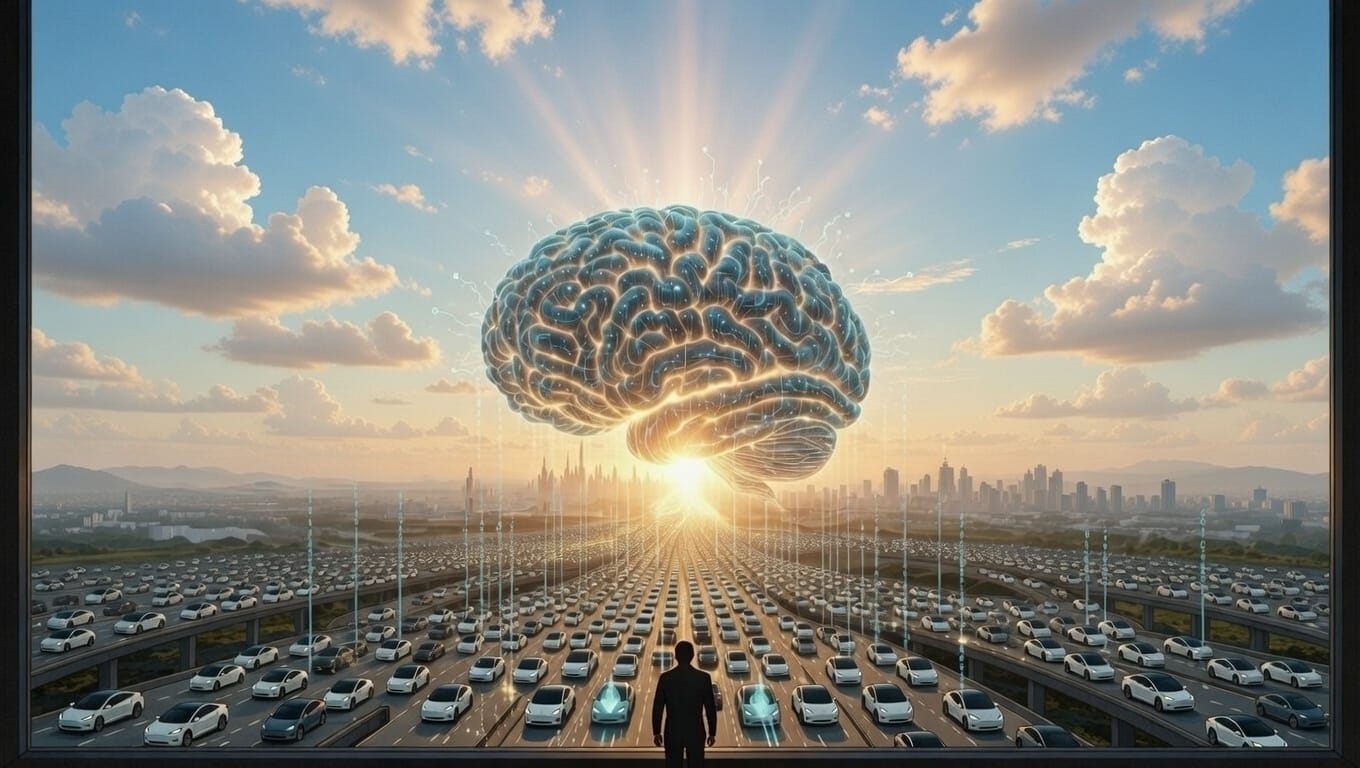
Tesla replaced that line with a loop:
- Data flows from the fleet.
- Feeds training.
- Training runs on real hardware.
- Improved models deploy back to the fleet.
- The fleet generates new data.
The loop never stops. The organism never sleeps.
3 Things Make This Loop Different From Every Other AI Deployment Pattern Out There.
1) It improves precisely where it fails. Not through random sampling or manual review, but because every human correction in shadow mode targets an exact gap in the model's understanding. The system is always learning from its own worst moments.
2) The lab and the field are the same place. Training on production silicon means the model that ships has already lived in its own body. No surprises at deployment. No tail-risk discovered after the fact.
3) Scale is the moat. More cars generate more data. More data produces better models. Better models earn regulatory approval. Approval puts more cars on the road. The loop doesn't just run, it accelerates.
That architecture will probably show up beyond cars. Anywhere AI runs in production and needs to improve from experience: medical imaging that learns from clinical outcomes, customer service systems that sharpen on escalations, trading models that adapt to regime changes.
The question is always the same: does your AI just run, or does it get better every time it runs?
One Question Worth Sitting With
Most AI deployments are frozen at launch. The model that ships is the model you get... Until someone retrains it months later, in a lab, far from the real world.
Tesla showed what happens when you close the loop between deployment and learning. The gap between a tool and an organism might come down to that single design decision.
The harder question follows from it: can you actually prove your AI is safe without running it at scale, long enough to see the tail events?
Statistical proof requires volume. Volume requires instrumented deployment in the real world. In practice, only the teams who've already built that loop can even start to answer.
Tesla can generate that proof in a quarter. For most companies, it would take decades, if they ever commit to it at all.
POST-WORK follows the slow collapse of the equation that tied economic growth to employment. Tesla's FSD might be the most vivid example yet of what comes next: an organism that learns faster than the humans it was built to assist.
Fourteen interlocking layers. A feedback loop that compounds every quarter. A system that feeds on the chaos of the real world and gets stronger from it.
The cars were just the beginning. The architecture is the story.
If you want to follow that story beyond cars, into offices, hospitals, banks, courts and everywhere AI runs in production... Get POST-WORK in your inbox.
Sources: